The Graduate School of Leadership (Shizenkan University) hosts “Medical Impact Night,” an event series dedicated to exploring leadership and solutions for challenges within the medical, nursing, and healthcare sectors.
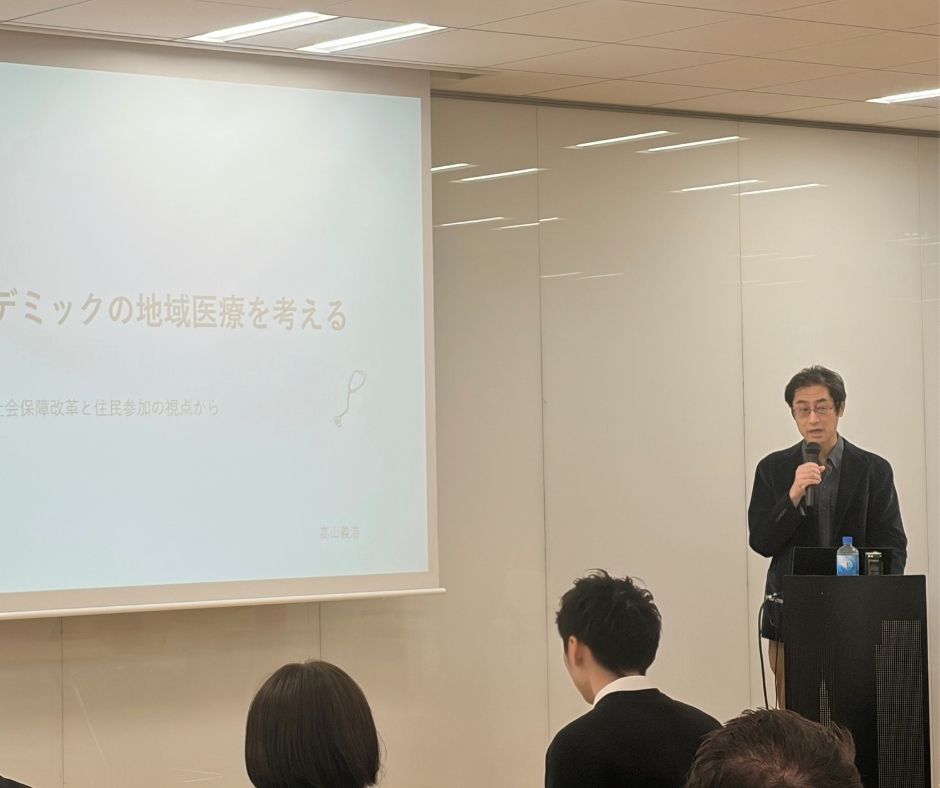
For our second session, we welcomed Dr. Yoshihiro Takayama from the Department of Infectious Diseases at Okinawa Prefectural Chubu Hospital. Drawing from his experience leading the frontlines of the COVID-19 pandemic and his practice in regional medicine, Dr. Takayama engaged the audience in a passionate discussion centered on the keyword “Community Participation”—and how to address challenges that medical experts alone cannot solve.
The session was moderated by Dr. Kenichiro Konno, a Shizenkan alumnus (Class of 2025) and the founder and CEO of Carus Holdings Co., Ltd.
Speaker Profile
Dr. Yoshihiro Takayama Deputy Director, Department of Infectious Diseases and Department of Community Care, Okinawa Prefectural Chubu Hospital After working at Saku General Hospital and the Ministry of Health, Labour and Welfare, Dr. Takayama has been active at the forefront of regional medicine and infectious disease control. During the COVID-19 pandemic, he supported the governor’s decisions as a policy advisor for Okinawa Prefecture. He continues to provide insights as an official Yahoo! News commentator.
The “Limits of Medicine” and the “Perspective of Daily Life” Revealed by the Pandemic
Dr. Takayama began his lecture by reflecting on the COVID-19 crisis. While social activities were restricted to prevent the spread of infection, the medical front witnessed significant “side effects”: cases where chronic conditions such as diabetes and alcohol dependence were uncovered, as well as a sharp decline in cognitive function and ADL (Activities of Daily Living) among the elderly.
“To suppress medical demand, preventive medicine that manages underlying conditions is crucial. However, during the pandemic, infection control took absolute priority, severing people’s lives and connections. As a result, we may have lost something profound,” Dr. Takayama remarked.
The Decision Behind the “Okinawa Model”: Facility-Based Care
During the Omicron wave, medical institutions in Okinawa were overwhelmed by an explosive surge in cases. In response, Dr. Takayama and his team led the creation of a “clinical path” for elderly facility residents, opting for care within the facility rather than reflexive hospitalization.
This was not an “abandonment of medical care,” but rather a pursuit of “what is best for the elderly.” Data revealed no significant difference in mortality rates between those hospitalized and those cared for in facilities. On the contrary, it became clear that the change in environment and the use of physical restraints in hospitals posed higher risks of worsening dementia and declining ADL.
“Hospitalization does not always equal safety. In some cases, the prognosis is better when a patient stays in a familiar place surrounded by staff they know.” This experience reinforced the vital importance of the “place of living” in regional healthcare.
“Neighborly Concern” (Osekkai): A Safety Net Anyone Can Provide
Finally, Dr. Takayama shared a case of a community supporting an elderly woman living alone. The woman, suffering from dementia and near self-neglect, was helped by neighbors who practiced a form of “benevolent nosiness” (Osekkai), which eventually led to intervention by visiting nurses. Furthermore, local high school students and residents stepped in to care for her pets (goats and dogs) while she was away—a natural emergence of support outside of formal systems.
“Regional healthcare cannot function through professionals alone. The strongest safety net is the ‘neighborly concern’ of residents—those who notice when a neighbor’s shutters haven’t opened in the morning,” Dr. Takayama said, emphasizing the need for a society where professionals and residents work together on equal footing.
Networking Session
Between lecture segments, a networking session was held with light refreshments. Speakers and participants were seen engaging in enthusiastic exchanges of ideas.
Announcement of the Next Event “3rd Medical Impact Night”
- Date & Time: Friday, March 6, 2026, 19:00–
- Guest: Mr. Toru Honda (Director, SHARE – Services for Health in Asian & African Regions)
We look forward to seeing you there.