
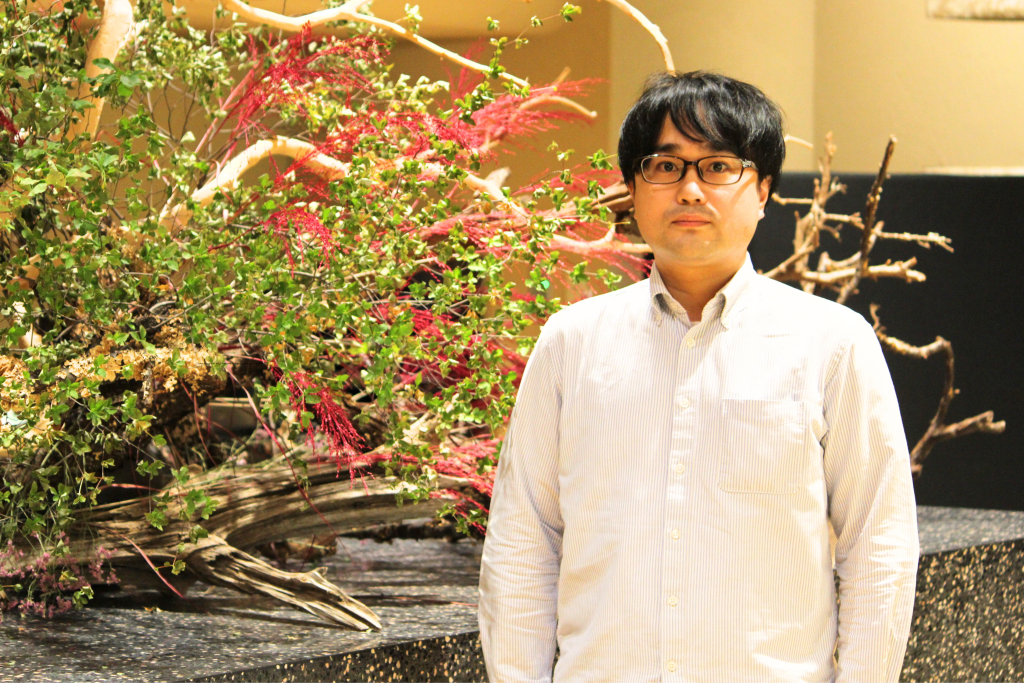
Sho Imamura (Class of 2027 | Vice President, Social Innovation Partners)
| The Social Innovators Scholarship is designed for practitioners who are actively working to address social issues and create social innovation. We spoke with Sho Imamura, the second recipient of the scholarship, who enrolled in August 2025. |
— First, could you please introduce yourself?
My name is Sho Imamura. I work at Social Innovation Partners (SIP), where we provide mid- to long-term funding as well as management support for organizational and business development to organizations addressing social issues.
— What kind of career path have you taken so far?
Before joining SIP, I worked at a general trading company and later at a consulting firm.
I first became interested in social issues through a seminar I joined at university. At the time, we focused on issues faced by socially vulnerable populations, such as homelessness, and learned mainly through fieldwork, visiting sites and engaging directly with communities. The seminar was led by a lawyer, who repeatedly told us something along the lines of, “Because you are in a privileged environment, you have a responsibility to contribute to society.”
Although I didn’t immediately translate those words into action, they stayed with me.
After graduating, I worked at a general trading company, investing in overseas power generation projects. Several years later, a late-night gathering with friends from university became a turning point. I don’t remember all the details, but among them were friends who had carried their sense of social purpose from our student days straight into practice, working in the field at NPOs and other organizations. Seeing them stirred something in me that had long remained unresolved. At the same time, I began to think that because I had taken a different first step into the business world, there might be a different kind of contribution I could make.
With those thoughts, I moved to a consulting firm and eventually joined SIP, where I am today.
— Why did you decide to apply to Shizenkan?
One reason was that I strongly felt the need to relearn management.
Although I had been involved in decision-making in practice, I felt the need to systematize how I think and judge in order to truly strengthen organizations and businesses. I was also serving as a board member of nonprofit organizations and facing management challenges across multiple organizations, which made me realize that I needed more comprehensive capabilities.
Another reason was that I wanted to reflect more deeply on what kind of society I genuinely want to help create, and which social issues I truly want to confront—like the leaders of the organizations we work with at SIP. Personally, I feel there are challenges in the movement of talent between the business and social sectors, and I wanted to reexamine such questions.
I had known about Shizenkan since its founding, having read President Tomoyoshi Noda’s book “リーダーシップの旅 (The Leadership Journey)”. In addition to the elements of a conventional MBA, I was attracted by its strong focus on leadership, and by the diversity of sectors—business and social—as well as generations.
That said, applying was not an easy decision. Balancing work for two years, the tuition, and time with my daughter, who had just started elementary school—these were very real hurdles.
What encouraged me to move forward was the existence of the Social Innovators Scholarship and conversations with people who were already studying at Shizenkan. Hearing concrete stories about how they secured study time and balanced life and learning made me feel that “with some ingenuity, it can be done.”
Also, in speaking with faculty members and alumni, I strongly sensed each person’s leadership, which left a deep impression on me.
Through these experiences, I became convinced that “now is the time to study at Shizenkan,” and decided to apply.
— You have been enrolled for five months. What kind of learning have you experienced?
I feel that learning at Shizenkan is premised on constantly moving back and forth between inquiry and practice.
In class, we are continually asked, “How would you decide, and how would you act?” Of course, there is knowledge input, but even more than that, there is a persistent effort to dig into why we perceive things the way we do. This approach runs not only through the liberal arts courses, but also through the more practical subjects.
The insights gained in this way are already influencing my practice. There are times when I use management frameworks, but I especially feel the impact when thinking about the axes along which I make decisions. I bring those questions and sensibilities back to Shizenkan again. This back-and-forth process has become extremely important to me.
What makes this possible is dialogue with my peers, supported by Shizenkan’s culture and the shared atmosphere there. Even when values differ, dialogue is possible. We earnestly seek to understand one another, challenge each other’s thinking, and grow together. I feel this is because Shizenkan carefully cultivates a space of high psychological safety. Such a place and such peers are truly rare and precious.
During my admissions interview, one of the interviewers told me, “Shizenkan is a good fit for people who carry questions.” I now strongly feel how true that was.
— What are your aspirations for the next two years?
My aspiration is to find the social issue that I want to devote my life to addressing. At the moment, I am still in the process of searching. Over the two years at Shizenkan, through dialogue with many people and by confronting a wide range of issues, I hope to shape a clearer vision of the path I want to pursue.
At the same time, I want to become someone who can contribute even more to my own organization and to the partner organizations that support and work alongside my learning at Shizenkan.
| Related Links
Application Information: Social Innovators Scholarship
Contact Shizenkan University Graduate School – Admissions Office Nihonbashi Takashimaya Mitsui Building 17F, 2-5-1 Nihonbashi, Chuo-ku, Tokyo 103-6117 E-mail: admissions@shizenkan.ac.jp |